

How does the density affect the performance of a bronze bushing?
As a supplier of bronze bushings, I've witnessed firsthand the critical role that density plays in determining the performance of these essential components. Bronze bushings are widely used in various industries, from automotive to aerospace, due to their excellent wear resistance, corrosion resistance, and self - lubricating properties. However, the density of the bronze material can significantly influence these performance characteristics.
1. Basic Understanding of Bronze Bushing Density
Bronze is an alloy primarily composed of copper and tin, with other elements such as zinc, lead, and aluminum sometimes added to enhance specific properties. The density of a bronze bushing is determined by the composition of the alloy and the manufacturing process. Generally, a higher density bronze bushing contains more closely packed atoms, which can lead to improved mechanical properties.
The density of bronze typically ranges from 7.4 to 8.9 g/cm³, depending on the specific alloy. For example, phosphor bronze, which has a relatively high tin content, usually has a density around 8.8 g/cm³. This density is crucial as it affects not only the physical but also the chemical and mechanical behavior of the bushing.
2. Impact on Wear Resistance
One of the most important performance aspects of a bronze bushing is its wear resistance. Wear occurs when two surfaces in contact move relative to each other, causing material removal. A higher - density bronze bushing often exhibits better wear resistance.
The closely packed atoms in a high - density bronze bushing provide a more stable structure. This means that under the action of friction, the material is less likely to deform and wear away. For instance, in a high - load and high - speed application, such as in a heavy - duty machinery engine, a bronze bushing with a high density can withstand the abrasive forces for a longer period.
In contrast, a low - density bronze bushing may have more voids and less - dense atomic arrangements. These voids can act as stress concentration points, leading to premature material failure and increased wear. When the bushing wears out quickly, it can cause increased friction, heat generation, and ultimately, the failure of the entire system.
3. Influence on Corrosion Resistance
Corrosion is another factor that can significantly affect the performance of a bronze bushing. A higher - density bronze bushing generally has better corrosion resistance. The dense atomic structure acts as a barrier against corrosive agents, such as moisture and chemicals.
In a marine environment, for example, where bronze bushings are commonly used in shipbuilding and offshore equipment, the bushing is constantly exposed to saltwater, which is highly corrosive. A high - density bronze bushing can resist the penetration of saltwater and the subsequent formation of corrosion products. The dense structure reduces the likelihood of oxygen and water molecules reaching the internal layers of the bushing, thus preventing corrosion from spreading.
On the other hand, a low - density bronze bushing may have pores and gaps that allow corrosive agents to penetrate more easily. Once corrosion starts, it can spread rapidly through the bushing, weakening its structure and reducing its service life.
4. Effect on Self - Lubricating Properties
Many bronze bushings are designed to be self - lubricating, which is a significant advantage in applications where regular lubrication is difficult or impossible. The density of the bronze material can affect the self - lubricating performance.
High - density bronze bushings can better retain lubricants. The dense structure provides more surface area for the lubricant to adhere to, and it can also prevent the lubricant from leaking out quickly. Some bronze bushings are impregnated with lubricants during the manufacturing process. A high - density bushing can hold the lubricant more effectively, ensuring a continuous supply of lubrication between the moving parts.


For low - density bronze bushings, the lubricant may escape through the voids and pores more easily. This can lead to a lack of lubrication, increased friction, and accelerated wear. In applications such as food processing machinery, where self - lubricating bronze bushings are used to avoid contamination from external lubricants, the density of the bushing becomes even more critical.
5. Considerations in Manufacturing
The density of a bronze bushing is also closely related to the manufacturing process. There are several methods to produce bronze bushings, including casting, powder metallurgy, and machining.
In casting, the cooling rate and the composition of the molten bronze can affect the density of the final product. A slow cooling rate generally results in a more uniform and higher - density structure. Powder metallurgy involves compacting bronze powder and then sintering it. The pressure applied during compaction and the sintering temperature can significantly influence the density of the bushing. Machining can also be used to modify the density of a pre - formed bushing, although this is usually a secondary process.
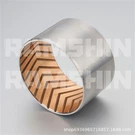
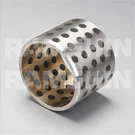
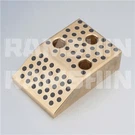
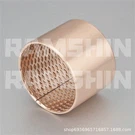
As a supplier, we carefully control the manufacturing process to ensure that the bronze bushings we produce have the optimal density for different applications. We offer a wide range of bronze bushings, including Bronze Sleeve Bearings, Self - lubricating Spherical Plain Bearing, and Oilless Bronze Bearing, each designed with specific density requirements to meet the diverse needs of our customers.
6. Application - Specific Density Requirements
Different applications have different density requirements for bronze bushings. In automotive engines, where high - speed and high - load conditions are common, high - density bronze bushings are preferred to ensure long - term durability and reliable performance. The engine's pistons and connecting rods rely on bronze bushings to reduce friction and wear, and a high - density bushing can better withstand the extreme conditions.
In the electrical industry, bronze bushings are used in switches and relays. Here, the density may be less critical in terms of wear and load - bearing capacity, but it can still affect the electrical conductivity of the bushing. A more dense structure may provide better electrical conductivity, which is important for efficient electrical transmission.
In the furniture industry, bronze bushings are used in hinges and other moving parts. In this case, a medium - density bronze bushing may be sufficient, as the loads and speeds are relatively low. However, the bushing still needs to have good corrosion resistance and self - lubricating properties to ensure smooth operation over time.
7. Conclusion and Call to Action
In conclusion, the density of a bronze bushing has a profound impact on its performance, including wear resistance, corrosion resistance, and self - lubricating properties. As a supplier, we understand the importance of density in different applications and are committed to providing high - quality bronze bushings that meet the specific requirements of our customers.
If you are in need of bronze bushings for your application, whether it's a high - performance automotive engine or a simple furniture hinge, we are here to help. Our team of experts can assist you in selecting the right bronze bushing with the optimal density for your needs. We invite you to contact us to discuss your procurement requirements and explore how our bronze bushings can enhance the performance and reliability of your equipment.
References
- ASM Handbook Volume 2: Properties and Selection: Nonferrous Alloys and Special - Purpose Materials. ASM International.
- Tribology Handbook. Edited by Bharat Bhushan. Wiley.
- Handbook of Copper and Copper Alloys. Edited by George E. Totten and D. Scott MacKenzie. CRC Press.