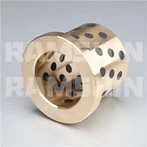
Bimetal Bearings – Keeping a Marine Diesel's "Heart" Beating for 20,000 Hours Non-Stop

Deep inside an ocean-going giant, the crankshaft spins at more than 100 rpm to drive a 100,000-ton hull through the waves. Supporting this force is not an ordinary plain bearing, but a "steel-back + copper-lead alloy" bimetal bearing. It turns the physical limits of two metals into engineered advantages:
1.Structural strength – the rigidity of steel
A high-carbon steel shell (180–220 HB) withstands peak oil-film pressures of 120 MPa-about the weight of 12,000 t pressing on a coin-without deformation.
2.Tribology – self-lubrication of the copper alloy
The CuPb22Sn4 running layer contains 4 % tin, forming an SnO₂ film that keeps the dry-friction coefficient down to 0.08. Once lubricant arrives, a hydrodynamic film 10–25 μm thick places the contact in the "zero-wear" zone.
3.Heat conduction – ten times that of Babbitt metal
The copper alloy's thermal conductivity of 210 W·m⁻¹·K⁻¹ whisks away 0.5 MW of frictional heat in seconds, preventing "bearing wipe."
4.Fatigue life – 20,000 h L₁₀ standard
In rig tests at 110 °C, 60 MPa, and 500 rpm, bimetal bearings reach fatigue-spalling life 3.8× longer than traditional tin-based Babbitt, satisfying IMO's mandatory requirement for ocean vessels: "major overhaul interval ≥ 5 years."
Case study:
In 2023, Hudong-Zhonghua fully adopted Chinese-made bimetal bearings (20MnCr5 steel shell + CuPb alloy) for the new MAN B&W 11G90ME-C10.5 engines of 24,000-TEU container ships. After six months of sea trials, bearing temperatures stabilized at 92 °C-11 °C cooler than the previous Babbitt generation-and fuel consumption dropped by 1.2 g/kWh, saving roughly USD 480,000 in fuel per vessel per year.
Bimetal bearings make a ship's power-train joints tougher, cooler, and more fuel-efficient-turning metallurgical science into every nautical mile.
Our company specializes in bimetallic bearings. If you have any needs regarding our products, please feel free to send a message to this email address: