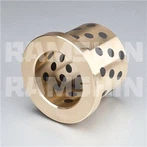
Tribology Unveiled: How Self-Lubricating Bearings "Service Themselves"
If a machine is a human body, then bearings are its joints-and tribology is the "sports medicine" that keeps those joints both flexible and durable. Though it sounds niche, this discipline governs the lifespan of every moving part, from spacecraft to coffee makers. In three quick takeaways, we'll decode its core logic and reveal why self-lubricating bearings have become the engineer's ultimate "lazy genius" solution.
The Tribology "Three-Body Problem": the eternal tug-of-war among friction, wear, and lubrication
Friction is the villain that resists motion, yet eliminating it completely causes slip failures-just as you need treaded shoes on ice.
Wear is friction's sidekick, nibbling material away until you're forced to replace parts.
Lubrication is the peacekeeping force. Traditional methods rely on external grease (think bearing butter) that traps grit and turns into "liquid sandpaper."
Self-lubricating bearings: locking the peacekeepers inside the material
Conventional bearings are pets that must be fed grease on schedule; self-lubricating bearings are camels that carry their own water:
Embedded lubricant particles (PTFE fibrils, graphite) burst open under load, forming a 0.1 µm lubricating film.
Rigid polymer backbones (polyimide, PEEK) act like rebar, ensuring the skeleton survives long after the film is spent.
Environmental immunity: Whether at –200 °C in space or 200 °C beside an engine, the film regenerates on demand.
Engineer's cheat codes: using tribology to defeat tribology
Surface micro-texturing: Laser-etched "drainage grooves" fling wear debris away like race-car aquaplaning.
Material matchmaking: An aluminum shaft running against a polymer liner cuts wear by 90 %-akin to "never rubbing an eraser on a cleaver."
Contaminant traps: Some self-lubricating compounds absorb moisture or dust, cocoon it into harmless micro-beads, and eject it.

Bottom line
When tribology shifts from "fix after failure" to "design it out," bearings cease to be consumables and become self-evolving mechanical organs. The next time you hear the quiet hum of a 3-D printer or an EV motor, remember: inside may lie a miniature desert oasis built by science for the sole purpose of elegant laziness.