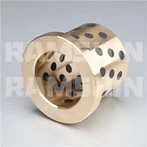
Bearing clearance is also known as bearing clearance. The so-called bearing clearance refers to the amount of movement when the bearing is not installed in the shaft or bearing housing, fixing one side of its inner or outer ring, and then moving radially or axially on the side with the bearing clearance that is not fixed. Depending on the direction of movement, PTFE soft strip bearings can be divided into radial clearance and axial clearance. The magnitude of the clearance (called operating clearance) when working the self-lubricating thrust gasket has an impact on the tumbling fatigue life, temperature rise, noise, vibration and other properties of the bearing.
Bearing clearance standards are not stipulated by the state to depend on the use: it is still quite a messy problem, briefly described as follows:
A. Selection criteria for clearance:
1. Large clearance group should be used when the temperature difference between the inner and outer rings is large, the oil-free self-lubricating composite bearing needs to reduce the conflict torque and the deep groove ball bearing accepts a large axial load or needs to improve the aligning performance.
2. When the rotational accuracy is required to be high or the axial displacement needs to be strictly limited, a small clearance group should be selected.
B. Clearance-related elements:
1. Cooperation between bearing inner ring and shaft.
2. Cooperation between bearing outer ring and housing bore.
3. The influence of temperature.
Note: The number of radial clearance reductions is related to the practice of cooperative parts with the amount of interference and the size of the general shaft diameter, and the wall thickness of the shell hole.
Bearing clearance
1. Sensory method
Check the axial clearance of the tumbling bearing with your fingers, this method is used when the shaft end is exposed. When the shaft end is closed or cannot be viewed with your fingers for other reasons, you can check whether the shaft can be rolled flexibly.
2. Measurement method
(1) Check with a feeler gauge, the operation method is the same as the method of viewing radial clearance with a plug, but the axial clearance should be
c=λ/(2sinβ)
where c - axial clearance, mm;
λ - feeler gauge thickness, mm;
β – bearing cone angle, (°).
(2) When viewing with a dial indicator, when the shaft is oriented at two poles with a pry bar, the difference in the dial indicator reading is the axial clearance of the bearing. However, the force applied to the crowbar should not be too large, otherwise the shell will undergo elastic deformation, even if the deformation is small, it will affect the accuracy of the measured axial clearance.