

Latest Products


Contact Us
- Building 3, No.81, Xinxing Road, Ganyao Town, Jiashan County, Zhejiang Province, China
- sales@ramshin.com
- +86-13484178032

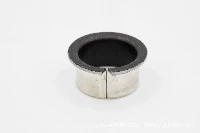
Bimetallic Bushing (JF800 Bimetallic Bearing)
1. Brief Introduction The bimetallic bushing is a rolled steel-bronze composite bearing. Its outer layer is low-carbon steel substrate for structural strength and impact resistance. The inner sintered bronze alloy layer is evenly distributed with oil storage dimples for lubricant storage. It is a boundary-lubricated bearing, suitable for rotary and sliding positions under low speed and heavy load with lubrication supply. Oil holes, oil grooves and positioning holes can be processed according to drawings. Both standard stock items and custom specifications are available. It is a cost-effective alternative to solid bronze bushings.
Description
1. Brief Introduction
The bimetallic bushing is a rolled steel-bronze composite bearing. Its outer layer is low-carbon steel substrate for structural strength and impact resistance. The inner sintered bronze alloy layer is evenly distributed with oil storage dimples for lubricant storage. It is a boundary-lubricated bearing, suitable for rotary and sliding positions under low speed and heavy load with lubrication supply. Oil holes, oil grooves and positioning holes can be processed according to drawings. Both standard stock items and custom specifications are available. It is a cost-effective alternative to solid bronze bushings.

2. Performance
High load capacity: The steel substrate offers high rigidity, excellent extrusion and impact resistance, and resists deformation under heavy loads.
Good wear resistance: The bronze alloy friction-reducing layer has a low friction coefficient. Oil pits maintain an oil film to reduce shaft wear and deliver longer service life than solid bronze bushings.
Cost advantage: Steel replaces most bronze material, cutting raw material cost while retaining the good friction properties of bronze alloy.
Flexible machining: Oil holes, positioning holes and oil grooves can be customized to match your assembly structure.
Easy installation: Split rolled construction fits tightly after press-fitting into housing bore for simple assembly.
Lubrication requirement: Grease or oil lubrication. Not designed for long-term dry running. For dry friction conditions, choose graphite embedded bronze bearings.
3. Application Scenarios
✅ Construction machinery: Hinge pins and boom bushes for excavators, loaders and forklifts ✅ Commercial vehicles: Kingpin, suspension and spring pin bushes for trucks ✅ Agricultural machinery: Lift arms and connecting rod joints of tractors and harvesters ✅ Hydraulic equipment, automation machines, machine tools, conveyors and lifting equipment ✅ Molds, hydraulic cylinders and low-speed heavy-duty transmission mechanisms
Working condition: Reciprocating or rotary sliding joints with low speed, heavy load and regular lubrication maintenance.
4. Q&A
Q1: How to choose between bimetallic bushings and graphite bronze bushings? A1: Choose bimetallic bushings if lubrication and regular maintenance are available for lower cost. Select graphite embedded self-lubricating bronze bushings for permanent dry-running applications.
Q2: Can custom sizes be made? A2: Custom service is available. ID, OD, length, oil holes and grooves can be made per your drawings. Samples can be provided for verification.
Q3: Does it require press fitting? A3: Yes. It is an interference-fit bushing and must be pressed into the housing bore. Free-fit assembly is not recommended.
Q4: What is the working temperature range? A4: Normal operating temperature: -40℃ ~ +120℃, short peak temperature ≤150℃. Special materials are available for high-temperature applications upon request.
Q5: What is the MOQ? Can I get samples? A5: Standard sizes are available for small orders. MOQ for custom parts depends on specifications. Samples are supported, and sample cost can be deducted from bulk orders.
Hot Tags: Bimetallic Bushing (JF800 Bimetallic Bearing),BIMETALLIC PLATE
You Might Also Like
